Roam Free Reports

RFN Gains 501c3 Status & Our Report Back from IBMP Meeting

Dear Friends,  

We hope this report finds you well and that you are enjoying the re-greening of the Earth! Frustration, sadness, and anger always seem to accompany the story of the last wild buffalo, so we wanted to start out with some good news: after a long wait, Roam Free Nation has finally gained our 501(c)(3) tax exempt status with the Internal Revenue Service! This means that any contribution that you make to our organization – monetary or in-kind – can be deducted from your federal income taxes!

Report Back from the IBMP Meeting

A plush toy buffalo looks out a car window at a real buffalo grazing.
Jaedin and Road Trip Ron travel through Yellowstone to visit with relatives on their way to the IBMP meeting.

RFN cofounder, Jaedin Medicine Elk, traveled to Chico Hot Springs last week, to attend the spring Interagency Bison Management Plan meeting. As to be expected, it was business as usual, though there are a few highlights we want to share with you.  

Gallatin National Forest Hits a “Refresh” Button

Gallatin National Forest Supervisor Mary Erickson has finally vacated the premises. She retired at the end of December, and from our perspective, she will not be missed. She was the queen of bureaucrats, always speaking in government-tongue, talking in circles and asking if it was the chicken or the egg who came first. Years ago she actually called the buffalo trap that used to be on Horse Butte a “tool of tolerance.” Interesting perspective, Mary. Bye! 

MTFWP to Amend West Side Hunt Permits

As you know, the Central herd migrates west into the Hebgen Basin, and north into the Gardiner Basin, making them doubly impacted by “management” actions. Buffalo from the Central herd are the only ones to migrate into the Hebgen Basin. Their numbers have been in decline for well over a decade, and in recent years, both Yellowstone and Montana Fish, Wildlife, & Parks (MTFWP) have recommended no killing of buffalo in the Hebgen Basin. This has totally been ignored by hunters and hunt managers. It is likely in response to this that FWP is taking some form of action.

Beginning this year, the state will reduce the number of state permits from 40 to 25. It’s not nearly enough — there should be a complete moratorium — but that’s 15 buffalo who will not be targeted, and with such an imperiled population, every little bit helps. 

Endangered Species Status Assessment

The Central herd is so imperiled, as is the entirety of Yellowstone’s wild buffalo population, that the U.S. Fish & Wildlife Service (USFWS) is currently considering Endangered Species Act protection for these gentle giants. Many of you have submitted comments throughout the process, which is critical for these buffalo (thank you). A USFWS representative spoke at the meeting and said that a decision on whether to list or not will be made by September 30, 2026. That’s a long ways off, and many species go extinct before the bureaucrats do the right thing. She also reported that the USFWS is currently working with the InterTribal Buffalo Council to gain indigenous knowledge about the buffalo. That report should be available to the public by the end of next year. 

Feedback from Our Cofounder

RFN Cofounder, Jaedin Medicine Elk represents at the IBMP meeting.  Footage by Jaedin.

RFN Cofounder, Jaedin Medicine Elk, had to brave this meeting alone, and as many of us do, he came away feeling frustrated, especially knowing that it is so important and so simple to do right by the buffalo.  In Jaedin’s words:  

This IBMP meeting felt like everyone at the table was tired and just wanted to get things over with. Some Tribal representatives were called out by other partners, who said ‘if you can’t vote or if you have to go back to your tribal counsel each time, then I don’t know why you are here at the table’. Other partners are concerned about following protocol, asking ‘if protocols aren’t being followed, why are we even doing this?’

It was nothing more than them questioning their own IBMP partners, questioning each other. The IBMP has been going for more than two decades and they still can’t figure anything out. Meanwhile, buffalo have to suffer. It’s weird Tribes don’t fight for more land for the last wild buffalo. The only advocacy they have are Tribal people wanting them fenced up on reservations. Not thinking about how it is to be a wild buffalo. We Tribal people are too busy trying to figure out how to help our own people. The sooner the better, sometimes forgetting who Mother Earth needs us to be. The ones sitting at the table are failing all of us. We as The People need to say something. The IBMP table fails us all, especially as Tribal people, especially the buffalo.

And yet faced with all of these decision-makers who don’t really make decisions that are meaningful to or respectful of the last wild buffalo, we press on for these sacred beings.  

This mom and calf remind us of what we fight for. Footage by Jaedin Medicine Elk.

Buffalo Advocates Launch Commercial About Beattie Gulch

This past month, our allies at the Alliance for the Wild Rockies and Yellowstone Voices launched a commercial that shows some of the horrors of the slaughter that takes place at Beattie Gulch. It aired on stations in Missoula and Bozeman, Montana, but it also aired on Netflix and Hulu. Maybe you saw it? Those who did sure had an awakening. The YouTube channel alone is reporting over 129,000 views. Imagine how many people watch Netflix and Hulu! We shared the commercial through our social media channels, but here it is now in case you missed it.

As always, thank you for allowing us to do this important work! We could not do it without you. And now you can get a tax break for helping us defend the last wild buffalo and wild nature. Please consider making a tax deductible donation to keep us in the field and in the faces of these ‘managers’. Thank You!

WILD IS THE WAY ~ ROAM FREE!  

Bull Wasted, Another Illegally Killed on Horse Butte

In our March report, we mentioned that the Blackfeet tribe recently announced that they would continue to hunt bull buffalo through the month of May in the Hebgen Basin. They have. The Shoshone-Bannock also continue to hunt, typically year-round as opportunity arises. Though, we’d be hard pressed to call either of the events that took place “hunts.”

Bull Wasted

Earlier this month, we were alerted by our friend and Horse Butte resident, who wants to remain anonymous, that a bull buffalo had been killed by Blackfeet hunters. This bull was sorely disrespected. The so-called hunters took his head, his back straps, and hindquarters and left the rest of him to rot. Local authorities were contacted, but the remains of the bull were taken to the local dump. She was able to document the gruesome scene and we share that with you here.

A bloated buffalo carcass in the sagebrush.

The image should speak for itself, but anyone who claims the buffalo to be a relative could not call this anything but a tragedy. It is also illegal to leave such waste. What a sad, sorry fate for this once-mighty bull. The so-called hunters should be hanging their heads in shame. We stand with our friend in pressing this issue until there is justice for this bull, and consequences for these killers. 

Bull Illegally Killed in Horse Butte Eagle Closure

More recently, another shocking event took place when hunters from the Shoshone-Bannock tribe killed a bull buffalo inside an area that is closed to protect bald eagles. Signs are posted everywhere making it very clear it is forbidden for humans to enter the area from December 1 through August 1. This bull should have been safe. The bald eagles — who are nesting right now – should also have been safe.

Luckily our supporter was there to document. Her footage shows the blatant disregard of native hunters killing a sacred buffalo in a supposed sanctuary for sacred eagles. Her images are below.  

Our friend contacted Roam Free Nation immediately. We did our best to support her. She contacted the local Forest Service Law Enforcement Office. She contacted the local game warden. She contacted the Gallatin County sheriff. She contacted Montana Fish, Wildlife, & Parks’ (FWP) Bozeman office, where she was finally heard. FWP Warden Sergeant Matt Wemple answered her call and came to the scene. A knife was left at the kill site, which he – having expressed being very concerned – kept as evidence. Other area residents were able to document the violation with high-powered equipment and are sharing their images with him.

The investigations are ongoing and aim to determine if the first bull was killed and left in an illegal manner; and to confirm if the other bull was killed in a restricted area, which would make it an illegal hunt. Several neighbors are becoming very concerned for the safety of themselves, their children, and their companion animals due to the shooting of high-powered rifles so close to residential areas and trails where folks recreate. These hunts – the gut piles and wasted meat – could also create human-grizzly conflicts, which never end well for the endangered bears.

The Gallatin National Forest Law Enforcement Officer is now in charge of the investigation(s). Please consider contacting the Gallatin National Forest Hebgen Lake Ranger District office at (406) 823-6961 and encourage them to see this through until justice is served!  

WILD IS THE WAY! ROAM FREE!  
 

Sadness and Anger

This is a long report, and for that I apologize – I hope you find it worth reading through to the end. We kept getting new information, and wanting to include it. Just as we were ready to share this with you, we found that the IBMP Bison Operations update had been posted – the first one this year. So we’ve updated our report to include some of that information. You can see their full report here.

A buffalo grazes in light snow

The “Hunt”

It is with great sadness and a whole lot of anger that I bring you our latest report from Gardiner. I was due to return my little rental car and return home to New York on Sunday the 24th, but as that day approached, we got word from our allies in Gardiner that groups of buffalo were approaching the park border – closer than we’d seen all winter. With some wrangling, and thanks to the generosity of our supporters, I managed to extend my trip by a few more days and return to Gardiner. Our co-founders, Stephany and Jaedin, made arrangements to get to Gardiner as well.

Unfortunately, by the time I got into town Sunday evening, blood had already been spilled. At dawn on Sunday a group of buffalo crossed the fateful line into Montana. Nez Perce “hunters” killed four buffalo there at Beattie Gulch, and wounded another, who fled across the road, leaving a trail of blood, only to die against a fence on the other side. The rest of the group fled back to the park, away from the firing line.

When I got into town, I visited the killing fields, to mourn and count the dead. For once, the kill sites had been cleaned up, with no waste left on the land, so I could not tell from the remains if the buffalo who died were male or female. The IBMP report tells us that one of those killed was an adult female, who almost certainly carried the next generation in in her womb. In town, one of the hunt rigs sat parked at a hotel, carrying the spoils of this war on wildlife in the back.

A pickup truck with dead buffalo parts in the back.

The next morning, Monday, the buffalo remained out of harms way. My morning rove was blessed by a passing wolf, who sat with his or her raven friends and watched some pronghorn go by. The buffalo who had retreated to the park stayed safe there for now, so I went up high above the town to get a good look at the Stephens Creek capture (and quarantine) facility.

A grey wolf sits with two ravens

Yellowstone’s Crime of Opportunity

It wasn’t until I looked at my photos later that evening that I saw there seemed to be many more buffalo held captive than when I was just in Gardiner a week before. Some were held in outer pens that I hadn’t seen used this year. Contact with Yellowstone’s Public Affairs Office confirmed my fears – Yellowstone had captured.

The trap with buffalo in the outer fenced in areas.

The outrage of this cannot be underestimated. This capture comes a year after a third of the population was killed or removed; in a winter when almost no buffalo have come out of the park; and just half a year after Yellowstone’s Bison Population Status Report stated, “The number of animals removed by IBMP partners should depend on the magnitude of the migration…” That report also said that removing zero bison this year would still leave the population numbers within the (extremely low) IBMP target population range.

Yellowstone captured some of the first buffalo to try to migrate out of the park this season – the leaders, their family groups, and surely pregnant females. Twenty-nine buffalo stolen from their homes, stolen from the lands that need them, and stolen from the public trust. And why? For their greenwashed domestication program. To put them through a battery of invasive tests, keep them in captivity for years, and then ship them off in livestock trailers to private and tribal herds – to be treated as livestock.

Yellowstone workers stand on catwalks above the trapped buffalo, poking and prodding them.

By the next day, Tuesday, Yellowstone workers were busy at the trap with the first step – the invasive tests. Here they test the buffalo for antibodies to brucellosis. Approximately 45% of Yellowstone buffalo have these antibodies – but that does not mean they actually have the disease, any more than a human with antibodies to chicken pox is walking around with that disease. And those that test positive?

They die.

Shipping to Slaughter

Tuesday evening we saw a game warden from the Confederated Salish and Kootenai Tribes in town, and with their hunt season long over, it could only mean one thing – shipment to slaughter.

Wednesday morning, we were up early, and sure enough, in the pre-dawn hours, the game warden and two trucks pulling trailers headed to the trap. By 8am, fourteen buffalo, including seven adult females, saw their Yellowstone home for the last time, speeding north in those trailers to their death.

Two trucks pull livestock trailers, and two other trucks follow.

Tears flowed. One of the drivers gave me the “one fingered salute”. I shouted at the passing trucks about killing pregnant mothers. All three of us, myself, Stephany, and Jaedin, were there to document, to witness, to say goodbye.

It is a tragedy that five buffalo were killed for crossing a line at Beattie Gulch. And it is an absolute crime that Yellowstone National Park captured twenty-nine buffalo and sent half of them to their death.

According to the IBMP report, five young buffalo were sent to quarantine, torn from their families and sentenced to a life of domestication. One buffalo died in the trap, and the park released nine back to the park. While it’s better than zero, releasing nine is not enough, and does not absolve Yellowstone of the blood on their hands.

Upset? Angry?

Call Yellowstone’s Superintendent Cam Sholly at (307) 344-2002
Email: Yell_Superintendent@nps.gov
Comment on their social media pages:

More information from the IBMP report

Again, you can see the official report, but here is our summary. In addition to the five buffalo killed last Sunday, two were killed on the north side by state “hunters” – most likely in a backcountry hunt, as we had not heard of these killings before. On the west side of the park, a total of nineteen buffalo from the endangered Central herd have been killed – thirteen by state “hunters”, four by Salish and Kootenai, and another two by Blackfeet just last week. We just heard, also, on the evening of March 31st, the last day of many of the tribes’ hunt seasons, that a whole family group was killed in Gardiner. We will give you more information on that as soon as we have it.

Someone sits on the ground filming a group of buffalo.

Thank you to our supporters for giving us the means to get out into the field with the buffalo. We hope to continue to build our presence on the ground, especially in Gardiner, where the buffalo face so many obstacles and enemies. Take action, share our information far and wide, speak for the buffalo, and please, continue to support us how you can.

From the field, for wild buffalo,
Cindy

Roam Free Nation Visits West Yellowstone

After leaving Gardiner I traveled down to West Yellowstone – on the west side of the park – the other main migration corridor for wild buffalo. The buffalo that migrate out the west side are all from the at-risk Central herd. For years Yellowstone has recommended there be zero hunting on the west side, but those calls have gone unheeded.

Indeed, West Yellowstone saw the only buffalo “hunting” to happen so far this year, with eighteen killed earlier in the winter. The survivors of those killings ran back to the safety of the park, and no more have migrated out there this winter.

So like Gardiner, to visit with any buffalo near West Yellowstone, one has seek them out inside the park, but unlike Gardiner, the park roads are closed, so I took to a borrowed pair of cross country skis for a beautiful, and exhausting, day.

A snowy scene with ski tracks.

The first group of buffalo I came across grazed and lazed in the sun. I sat a ways away, listening to the sound of their hooves in the soft ground, the rhythm of their chewing. Similar to in Gardiner, we had a chat about which way is safe, and which way leads towards the invisible line of the park border and certain death. I think they know. I hope they know.

A group of buffalo graze by a river.

Many of the tribes will end their hunt season at the end of March. Unfortunately, the Northern Arapaho allow hunting through the end of April, the Blackfeet permit hunting bulls through the end of May, and the Shoshone-Bannock hunt year round. What this means is that the traditional spring migration to Horse Butte and other areas west of the park may be met with bullets.

In the afternoon I briefly spotted another group, heading along the river, thankfully further into the park. One after another, down the hill to disappear into the willows. A small yearling struggled slightly with the loose gravelly slope. The herd was there, to show the little one a different route, to show the little one the way.

Two buffalo graze by a marshy river.

If only we humans would stop interfering, these matriarchs, these leaders, would show us all the way to true restoration.

From the field, for wild buffalo,
Cindy

Hello to Spring, Farewell to Gardiner

The buffalo are still staying safe in the Park, and my time in Gardiner is coming to a close. I’ve actually extended my stay twice – because buffalo were getting close to the park boundary, but thankfully, each time was a false alarm. They are moving around, though, grazing and getting strong, and taking over the roads in the park, letting everyone know that they own the place!

A herd of buffalo in the road with a bunch of cars stuck behind them.

Hunt parties still stalk the borders of the park, either after elk, or just waiting impatiently for buffalo to kill.

It is so backwards, because all who are buffalo people should be here at the edge of the park, not waiting to kill but waiting to welcome the buffalo who come down from the high places, waiting with celebration and song, waiting to tell the buffalo how important and needed and loved they are.

Instead, I get up every morning and take my first loop around, hoping NOT to see buffalo, hoping I have to drive well into the park to find our friends.

But that’s how it is under this Interagency Bison Mis-Management Plan – governments and entities and agencies and people with guns preventing the buffalo from bringing their healing presence to this land.

So, we hope NOT to see buffalo, we hope they stay safe in the park. And as spring starts showing her face, it seems more and more likely that they will stay put, and will be spared here on the north side this season.

What a difference a week makes!

Spring is arriving, most certainly. The snows have gone in the low areas and the southern slopes. I have seen robins and bluebirds, and the ticks are out in full force. The road I struggled with just over a week ago is bare dirt. Trails are sloppy, and my boots caked in mud. While the mornings are still cold, by afternoon the days are warm, and the buffalo laze in the sun. May they stay safe and strong, and rebuild their numbers.

A group of buffalo walks in the sun.

And here, on the outside, we’ll keep fighting for a world where we welcome them with celebration and song, instead of bullets and fences.

From the field, for wild buffalo,
Cindy

The Tragedy of Quarantine

By Sunday it was all quiet again. The bulk of the hunters left town, the game wardens left town. A few Montana based treaty hunters remained, still after a few elk. The lull allowed me to turn my attentions elsewhere for a bit.

I visited the killing fields of Beattie Gulch – to mourn, to reflect on all of the damage done there in the past years. I was surprised, after hearing that last spring they filled a fourteen foot trailer and three dumpsters with wasted remains, to see that Beattie Gulch is still a graveyard. Skeletons rise from the grasses; feet litter the field; pelts wear away, slowly returning to the earth. A tail, withered and hardened, stands up from a pile of remains, fur waving in the wind. I wander, until a couple fresh elk kill sites bring me back to the present.

A buffalo ribcage lies in grass, with snowy mountains behind.

For the last few days, I’ve focused on the trap-turned-quarantine facility at Stephens Creek, as well as the quarantine pens at Corwin Springs.

Corwin Springs seems to hold thirty-five buffalo, a mix of juveniles and adult females. Their yellow ear tags look strangely out of place. They mill listlessly around a double fenced hill along the highway, grazing on the remains of dry yellow grass. Penned in for a year or more, the wildness is there, but their wild lives are a distant memory.

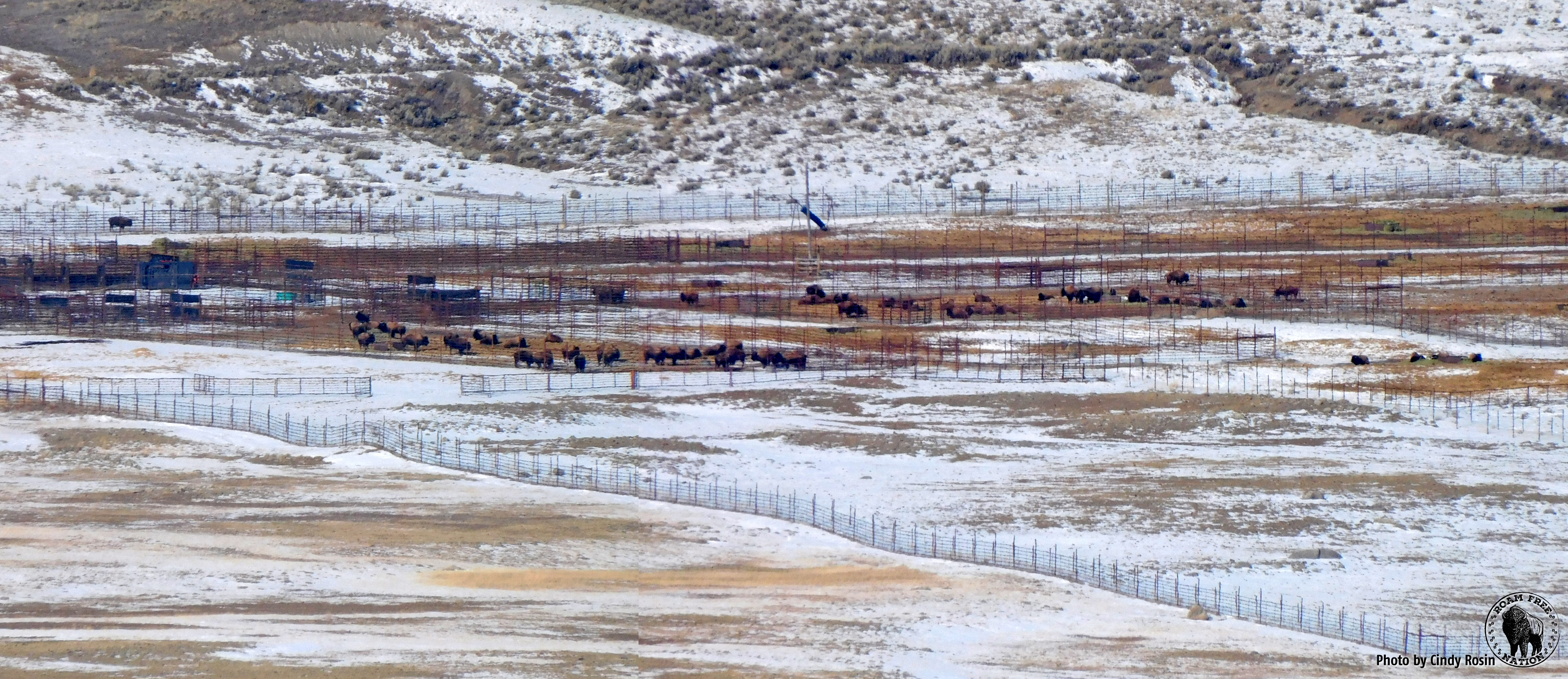
The Stephens Creek trap, unused this year for trapping, is a larger quarantine holding facility. It is along the base of a mountain, in Yellowstone Park, and in a huge closure to “protect” (i.e. “hide”) it from the public. It’s maze of fences and pens and chutes mean it’s hard to see how many buffalo are held captive there, but I photographed from up high, and count fifty-three buffalo, though there are likely more out of view.

A sign reading "Closed Area – Keep Out"

This is, of course, after the transfer of 116 imprisoned buffalo to Fort Peck in early February – not to roam free, mind you, but to another phase of quarantine. I think of the remaining buffalo, seeing their friends loaded up onto trailers, wondering where they’ve gone.

The capture facility is big – and the area filled with buildings, heavy equipment, pens for the horses, piles of dirt and hay. Despite the large fenced in area, when I look most days, the buffalo are crammed into the inner pens.

A photo of buffalo behind fences.
This is a composite photo – you can zoom in to see the details.
Notice the lonely young buffalo outside the fence in the upper left corner.

Monday morning, I stop to look over at the trap with binoculars. The buffalo are spread out to one of the outer pens for once. Suddenly, they start to run, all in the same direction, all towards the center pens. And that’s when I realize – the center pens are where the food arrives. They’ve basically turned these wild buffalo into feedlot animals. This is the tragedy of quarantine. It’s maddening, and just demonstrates so clearly why this is absolutely wrong for the last wild buffalo.

Buffalo stand behind fences on a pile of hay

When the buffalo take off running towards the hay drop, I see another incredibly sad thing. There is one lone young buffalo on the outside. Not trapped by fences and wires, but trapped all the same, because she (or he) doesn’t know where else to go. All her family is in there. On another year, groups of free buffalo would have passed by, and the young one would have been adopted, but not this year. What will be her fate? It seems like all the options are bad.

I am so saddened by this trap. I am angered by those that should be allies supporting quarantine. How can people not see clearly past this culture’s inability to treat buffalo as anything but cattle? Of course we want buffalo roaming far and wide, returning to all of their ancestral lands – but on their terms, on their own four feet, families intact, migratory instinct leading the way.

A line of buffalo walks in the snow.

In the field, for wild buffalo,
Cindy

In the Absence of Buffalo, Hunters Target Elk

The buffalo are still safe in the park here in Gardiner, but things are heating up all the same. On my way back into town Wednesday evening, I noticed that game wardens from one of the treaty hunting tribes had arrived in town. They are only here if they have a hunt party on the ground, so I knew the hunters couldn’t be far behind.

I don’t know what they expected to find, though, as the buffalo were still all well inside the park. Some of the treaty tribes kill elk or other species under treaty right, but others do not, so they are just here in hopes of finding a buffalo to kill.

I got out early on Thursday in case there was any hunt activity, but it was a quiet day. The game wardens were out and about, but I saw no evidence of hunting. I went into Yellowstone to spend some time with the buffalo there, and most of the way I was driving near an obvious hunt rig – a big pickup with a game sled strapped in the back – as they just enjoyed a day in Yellowstone. It seems that this is what it takes, a year where the buffalo are too few, the winter too mild, for them to be available to kill – this is what it takes for this hunter and their family, who had come from quite far away, to just enjoy the wonders of this land in peace. I even passed one of the tribal game wardens enjoying a park day as well, though I suppose their job gets a little dull on a peaceful year such as this.

Four buffalo in the snow near a tree.

Friday seemed to be the start of the weekend in earnest, with hunters showing up from at least four different tribes. The morning started with the “hunt meeting” at Beattie Gulch – not that there’s anything to see there, but maybe for “old times’ sake”?

Afterwards, the action moved up the mountain. 


Mostly you hear us talk about the killing fields of Beattie Gulch – the bottleneck just at the northern border of Yellowstone. But there’s another area where buffalo migrate out of the park here – often bull bachelor groups – and that is the mountainous area above town, where the windy dirt Jardine Road travels up a hilly sagebrush landscape. Now normally Jardine Road is a well packed, well traveled dirt road – easy to drive on in just about any vehicle. But add a few layers of fresh snow, and then some warm afternoon temperatures to get it all nice and soft… My little rental car wasn’t up to the task. I tried driving up Jardine Tuesday afternoon, and when I stopped at a pullout to scope out the area… I couldn’t get going again. I went back a bit, and then tried, and no luck. I ended up having drive the little car backwards down the hilly road to a flat junction where I could turn around. It was scary, but also pretty darn comical. But the moral of that story is that I was wary of trying to drive that road again.

But now, all the hunters are up the hill, so I had to brave Jardine. I went in the morning, while temperatures were still well below freezing, and managed to get up the road with very little trouble! Now I know I just have to get back down before the day warms up too much.

So up Jardine, the hunt rigs are all over – some are just scoping from the high pullouts looking for buffalo, and others are hunting elk on the high slopes. Walking in the hills Saturday morning, I see three cow elk carcasses from the past few days, though those are just the ones the ravens and eagles led me to. I know a bull elk was taken somewhere, as I saw hunters with the head. Another hunt party works over a fresh kill. I’ll admit that I mourn for the elk dying on the mountain, but also I recognize that, unlike the buffalo slaughter, these are people exorcising treaty rights in a way that does not endanger a population. Elk are far more numerous, and are allowed all of the habitat and freedom that a wildlife species should have. Certainly, the ravens and eagles and coyotes are also enjoying the boon (though hopefully not with a side of lead ammunition).

Ravens feed on the bloody ribcage of an elk.

As the day warms, I head back down the hill, not wanting to get stuck again. I’ll travel into the park to visit with the buffalo, grateful for this time to be here with buffalo in peace.

A bull buffalo looks at the camera.

From the field, for wild buffalo,
Cindy

RFN Returns to Gardiner

I arrived in Gardiner Sunday evening. We had heard from allies that there haven’t been buffalo near the park border, but the sinking feeling I get when pulling into the Gardiner Basin is still there. I love returning to these mountains, to the buffalo – I’d been smiling since seeing the mountains of Montana first came into view.

But Gardiner? So often winter in Gardiner means bloody slaughter and sadness. So as I get closer to town, despite knowledge that the buffalo have been staying safe in the park, I’m still scanning passing trucks to look for hunt rigs, to look for body parts in the back. I see vehicles stopped on the gravel “low road” that runs parallel to the freeway and I panic, but realize they’re tourists, stopped to look at some bighorn or pronghorn. Finally arriving, I see the land is quiet, empty of buffalo, and empty of “hunters”.

The next morning, I check all the regular spots outside the park, and patrol all the areas we’d normally find buffalo this time of year. The land is beautiful, covered in a bit of fresh snow, and without the gunfire, without the bloodshed, it’s peaceful and serene. But without the buffalo, the land, however peaceful, feels lonely.

A snowy field with mountains in the background.
The fields just before Beattie Gulch are empty of buffalo.

This winter here in Gardiner, on the north side of Yellowstone, the buffalo never migrated out of the park, so they never met the firing line at the border. It has been a very mild winter, frighteningly so. In a mild winter the buffalo don’t need to seek food at lower elevations. The snows up high are not so deep – at least to a buffalo. So this mild winter has certainly spared buffalo lives.

But we cannot forget that nearly a third of the entire Yellowstone population of wild buffalo were killed or stolen from the land last season. That is a lot less buffalo to find their way out of the park. And those who were killed or removed last year – those who are killed or removed every year – are the leaders of migrations out. These slaughters, these captures, this quarantine – they’re not just killing buffalo, but they’re killing migratory memory as well.

But not this year.

A snowy field dotted with many buffalo.
In Lamar Valley, buffalo roam freely.

Once I was confident there were no free roaming buffalo outside the park, I went into Yellowstone to find our friends. Between Mammoth and Lamar Valley I counted around 450 buffalo. They are closer to the northern end of the park than we’d last heard, and a little close for comfort, but for now they are safe. With the mild winter, the buffalo friends I encountered looked healthy and well fed. The mamas sported beautiful round bellies that spoke of the coming spring and the coming generation. It is incredible to be among our wild buffalo relatives without the death and destruction of the past few winters.

Two female buffalo walk in the snow.
We hope these beautiful mamas bring their calves into the world in peace.

The next day brought a bit of new snow, and some movement of buffalo in the park, but not so much as to make us worry. It also brought some incredible time spent near a herd with a few young bulls who definitely have a bit of spring fever. I leave you with a bit of video of that wild dance.

Thank you for supporting wild buffalo, and for supporting us. Anything you can contribute to keep getting us out into the field is appreciated.

From the field, for wild buffalo,
Cindy (RFN board member)

Mostly Quiet on the Western Front

Dear Friends,

It has been a while since we’ve been in touch, mainly because there has not been a whole lot going on. This winter continues to be a mild one, and last year’s massacre removed over a quarter of the population, so there has been very little migration out of Yellowstone.

A small group of buffalo stands by a river deep inside Yellowstone.

There are no buffalo in the Gardiner Basin, along Yellowstone’s northern boundary. As of earlier this week, the closest buffalo were miles deep within the park, in the Blacktail Plateau region. The lack of buffalo, however, has not stopped treaty ‘hunters’ from coming into the Gardiner Basin to hunt. Elk are being killed, and likely bighorn and other species as well.

In the Hebgen Basin, west of Yellowstone’s boundary, eighteen buffalo have been taken by ‘hunters’. Most never even made it to the highway, which is less than half a mile west of the park boundary. These are all buffalo from the imperiled Central herd, buffalo who Yellowstone continues to warn ‘hunters’ and hunt managers not to kill. But, as we see, the ‘hunters’ could care less. Montana’s state hunt ended on Thursday, February 15, so at least that pressure is off. Treaty ‘hunting’ seasons will remain open into April, with some tribes continuing to kill year-round. Nevertheless, there are currently no buffalo available for them to kill.

After last year’s tragic slaughter we remain hopeful that the majority of these killers will get skunked.

Even though there’s not much going on we will soon be heading into the field to spend time with our relatives, the buffalo. We could really use your support to enable our efforts to monitor migration and document.

Someone sits by the road filming a group of buffalo in a snowy field.

Billboard Outreach

In other news, our billboard campaign sponsored by our friends at the Alliance for the Wild Rockies is ongoing. We have seven billboards up across western Montana and as far east as Billings. The billboards read, “Save Yellowstone Buffalo. Stop Buffalo Genocide.” We have heard from quite a few people who have seen them, so they are getting a lot of attention.

In the Media

In the media, the Daily Montanan gave good attention to the buffalo. The top ten most read commentaries in 2023 included Alliance for the Wild Rockies’ executive director Mike Garrity’s “Close Beattie Gulch Before Someone Gets Killed” at #3, RFN co-founder Stephany Seay’s “Cease Fire! The Yellowstone Bison Need a Chance to Recover” at #8, while our close ally, Steve Kelly, president of the Council on Wildlife & Fish, had two of his excellent commentaries about wild lands and government abuse at #9 and #10. Steve also wrote, “Buffalo Genocide: How History Rhymes its Repetitions”, which also ran in the Missoulian.

Native News Online chose RFN co-founder Jaedin Medicine Elk’s “An Open Letter to Tribes Participating in the Yellowstone Buffalo ‘Hunt’” for their most read opinions and guest opinions of the year.

Stephany was invited back to speak with our friend Joe DeMare on his podcast, For A Green Future. She gave a brief update about the current situation with the buffalo. You can listen to it here. It starts at 12:29.

Stolen Buffalo

In other news, 116 once-wild buffalo who were stolen from their Yellowstone homelands and forced through the quarantine (domestication) process were sent to the Ft. Peck Reservation, where they will be distributed to other tribes.

A captured buffalo looks out from behind a chained gate.
This is what quarantine looks like.

Many people are celebrating this event, but one can only do so if they look at things purely from the human perspective. From a buffalo’s perspective, there’s not much to celebrate because they’ve been captured, run through an industrial livestock trap, separated from their families, some dying during the handling process, kept in captivity, and taken away from their homes. Of course we want to see wild buffalo back on all the lands that are their birthright. But it should happen on their terms, through migration and not quarantine.

Well, that about sums it up for now. As we said, we’ll be heading into the field soon so will have more to share with you then. As always, thank you for being with us for wild buffalo and wild nature.

WILD IS THE WAY ~ ROAM FREE!

A Flurry of Activity

Dear Friends, 

Things are beginning to pick up, some of it positive and exciting, and some of it business as usual.  

A bull buffalo stares at the camera

THE “HUNT”

The Montana state bison “hunt” began on November 15. Eight bulls, from the imperiled Central herd, have already been killed by state hunters near West Yellowstone, in the Hebgen Basin. Yellowstone National Park has been warning against killing any buffalo in the Hebgen Basin for many years now, because the Central herd – the truly last wild, migratory buffalo – continues to decline. The Central herd migrates both into the Hebgen Basin (to the west) and the Gardiner Basin (to the north), so they are doubly impacted by mismanagement actions. In the Gardiner Basin, both the Northern herd and Central herd move into harm’s way. But only the Central herd migrates into the Hebgen Basin, so by refraining from killing there, at least some Central herd buffalo are protected. These warnings by the Park’s bison biologists continue to fall on the deaf ears of both state and treaty hunters. However, due to the continuing decline of the Central herd, Montana Fish, Wildlife & Parks are proposing to reduce the number of state licenses for next year from 40 to 25 in the Hebgen Basin. It’s still 25 too many, but it’s something.

Winter has been slow to arrive. West Yellowstone (Hebgen Basin) is just now starting to get some snow. It may be a mild winter this year, and if so, it could ease human-caused hardships on the buffalo. But, just as we need the snow so the rivers will be full in spring, the buffalo need to roam, to express themselves upon the earth and heal the wounded land.  

Buffalo graze along a snow covered riverbank.

MEDIA TRACTION

There’s been quite a flurry of activity in the past couple of weeks. Roam Free Nation joined with our allies, the Alliance for the Wild Rockies, Council for Wildlife and Fish, and the Gallatin Wildlife Association in sending a letter to Gallatin National Forest Supervisor Mary Erickson, urging her to close the Gardiner Basin’s Beattie Gulch (“the killing fields”) to buffalo hunting. We raised concerns about the serious public safety issues, and of course the slaughter the buffalo suffer at this bottleneck migration corridor on the northern edge of Yellowstone National Park. Ms. Erickson is the perfect bureaucrat who responded with policy jargon that avoided the issue entirely. To support our effort, Mike Garrity, executive director of Alliance for the Wild Rockies, wrote a column, “Alliance Asks Forest Service to Close Bison Hunting Area Next to Yellowstone National Park Before Someone Gets Killed”. Soon after, Roam Free Nation’s latest op-ed started making the rounds, “Cease Fire! Yellowstone Buffalo Need to Recover”.

TAKE THE POLL! VOTE “YES” TO CLOSE BEATTIE GULCH! 

Shortly after that, the Montana-based Bozeman Daily Chronicle began a poll asking if Beattie Gulch should be closed to buffalo hunting. We sent out a last-minute alert and so many of you responded! Thank you! As of this writing, the poll is still open to voting – so visit this link and make your voice herd now! The “yes” votes were up to 82.2% in favor of closing Beattie Gulch!

NEW BILLBOARD UP!  

As all of this was taking place, our strong allies at Alliance for Wild Rockies and Council for Wildlife and Fish, like last year, got some billboards in the works! They used Roam Free Nation’s image of a mom and baby buffalo, with the message: “Save Yellowstone Buffalo. Stop Buffalo Genocide.” There is currently a billboard up in Billings, Montana, and more to come in Missoula, Livingston, Bozeman, and Helena. We give thanks for all of their support!

A photo of a billboard against a blue sky that says:
SAVE YELLOWSTONE BUFFALO
STOP BUFFALO GENOCIDE

THE HARD TRUTH

Just the other day, our friend and ally, Steve Kelly, of Council for Wildlife and Fish had a really powerful column published, “Stop Buffalo Genocide and a Repeat of History”, representing our billboard and urging folks to contact Gallatin National Forest Supervisor Mary Erickson to close Beattie Gulch to buffalo “hunting”. You can take that action right now by emailing her at mary.erickson@usda.gov.  

KEEP ROAM FREE NATION IN THE FIELD! 

Roam Free Nation will soon be heading into the field to monitor the situation and defend our relatives, the buffalo. We need your support, however you can offer it. We give thanks to you and all of our allies for standing up for the last wild buffalo!  

Wild is the Way! Roam Free!  

~ Stephany Seay
Co-founder, Roam Free Nation