
By Sunday it was all quiet again. The bulk of the hunters left town, the game wardens left town. A few Montana based treaty hunters remained, still after a few elk. The lull allowed me to turn my attentions elsewhere for a bit.
I visited the killing fields of Beattie Gulch – to mourn, to reflect on all of the damage done there in the past years. I was surprised, after hearing that last spring they filled a fourteen foot trailer and three dumpsters with wasted remains, to see that Beattie Gulch is still a graveyard. Skeletons rise from the grasses; feet litter the field; pelts wear away, slowly returning to the earth. A tail, withered and hardened, stands up from a pile of remains, fur waving in the wind. I wander, until a couple fresh elk kill sites bring me back to the present.

For the last few days, I’ve focused on the trap-turned-quarantine facility at Stephens Creek, as well as the quarantine pens at Corwin Springs.
Corwin Springs seems to hold thirty-five buffalo, a mix of juveniles and adult females. Their yellow ear tags look strangely out of place. They mill listlessly around a double fenced hill along the highway, grazing on the remains of dry yellow grass. Penned in for a year or more, the wildness is there, but their wild lives are a distant memory.


The Stephens Creek trap, unused this year for trapping, is a larger quarantine holding facility. It is along the base of a mountain, in Yellowstone Park, and in a huge closure to “protect” (i.e. “hide”) it from the public. It’s maze of fences and pens and chutes mean it’s hard to see how many buffalo are held captive there, but I photographed from up high, and count fifty-three buffalo, though there are likely more out of view.

This is, of course, after the transfer of 116 imprisoned buffalo to Fort Peck in early February – not to roam free, mind you, but to another phase of quarantine. I think of the remaining buffalo, seeing their friends loaded up onto trailers, wondering where they’ve gone.
The capture facility is big – and the area filled with buildings, heavy equipment, pens for the horses, piles of dirt and hay. Despite the large fenced in area, when I look most days, the buffalo are crammed into the inner pens.
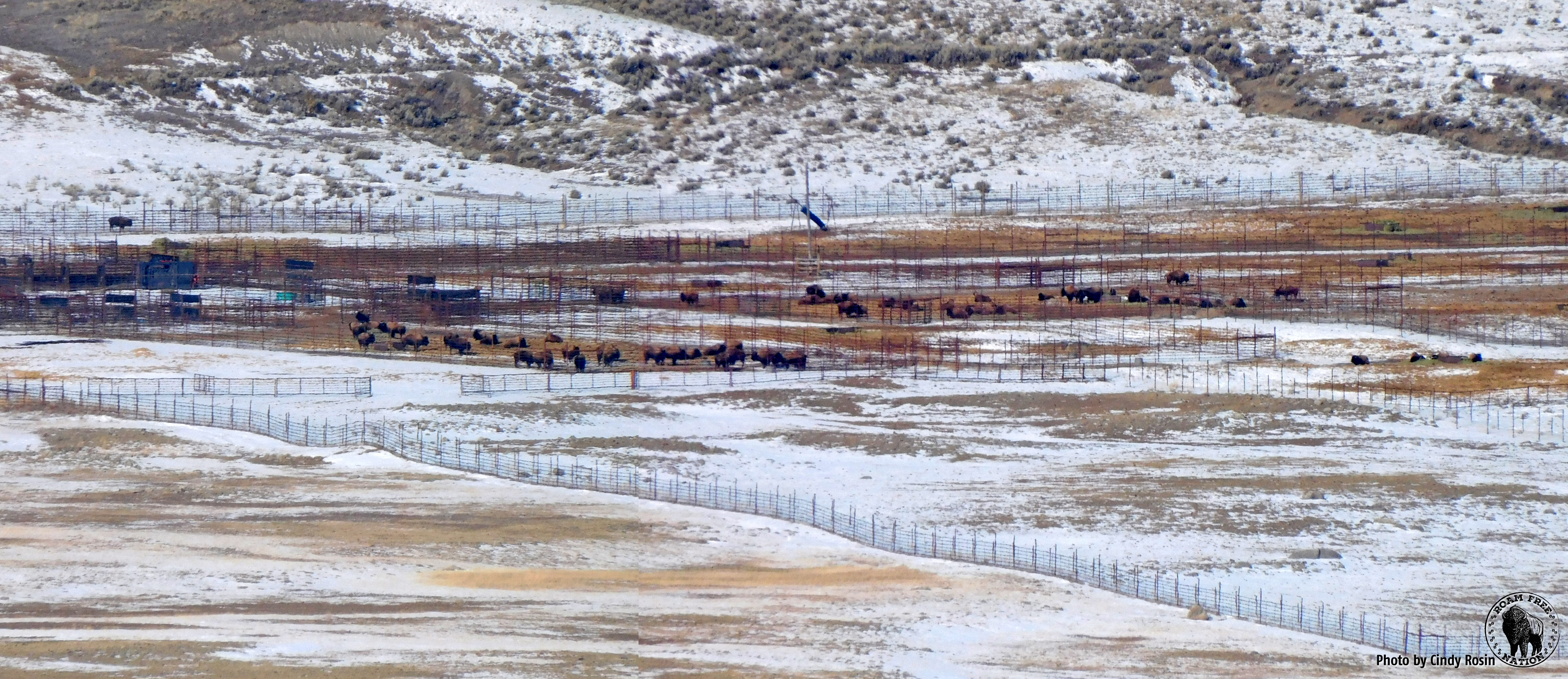
Notice the lonely young buffalo outside the fence in the upper left corner.
Monday morning, I stop to look over at the trap with binoculars. The buffalo are spread out to one of the outer pens for once. Suddenly, they start to run, all in the same direction, all towards the center pens. And that’s when I realize – the center pens are where the food arrives. They’ve basically turned these wild buffalo into feedlot animals. This is the tragedy of quarantine. It’s maddening, and just demonstrates so clearly why this is absolutely wrong for the last wild buffalo.

When the buffalo take off running towards the hay drop, I see another incredibly sad thing. There is one lone young buffalo on the outside. Not trapped by fences and wires, but trapped all the same, because she (or he) doesn’t know where else to go. All her family is in there. On another year, groups of free buffalo would have passed by, and the young one would have been adopted, but not this year. What will be her fate? It seems like all the options are bad.
I am so saddened by this trap. I am angered by those that should be allies supporting quarantine. How can people not see clearly past this culture’s inability to treat buffalo as anything but cattle? Of course we want buffalo roaming far and wide, returning to all of their ancestral lands – but on their terms, on their own four feet, families intact, migratory instinct leading the way.
