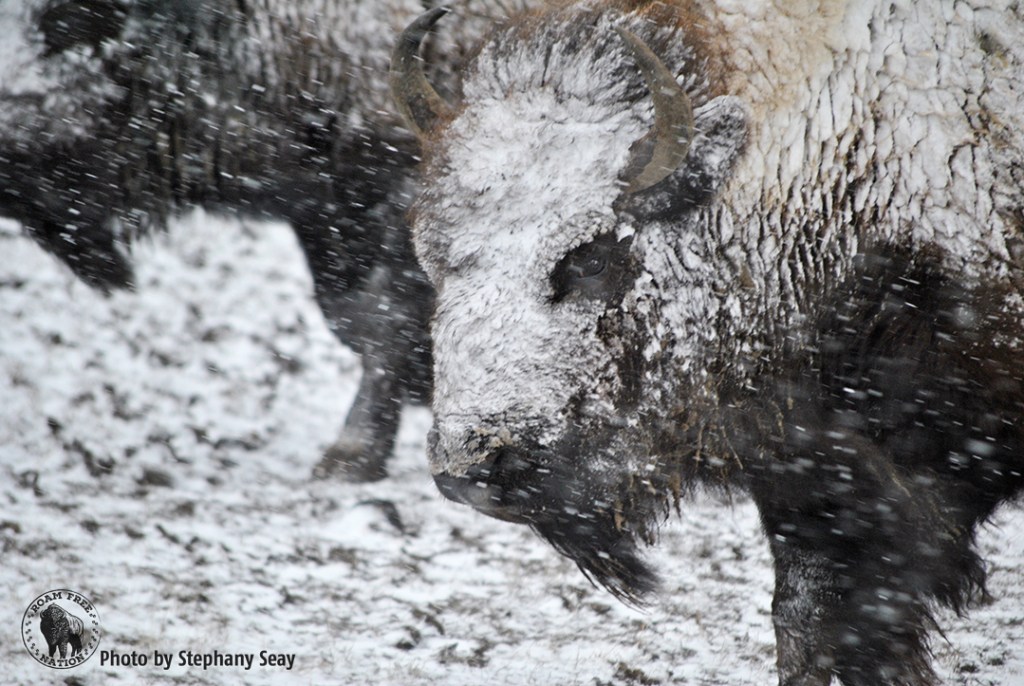
We hope you are enjoying the blossoming of spring. Here in Montana we are having warmer days, flowers are blooming, but we’re still getting a few snow showers. Buffalo calving season is well underway! Little red miracles decorate the landscape. Unfortunately, buffalo are still being shipped from Yellowstone’s trap to a slaughter facility in Helena, while most hunting has just now ended.
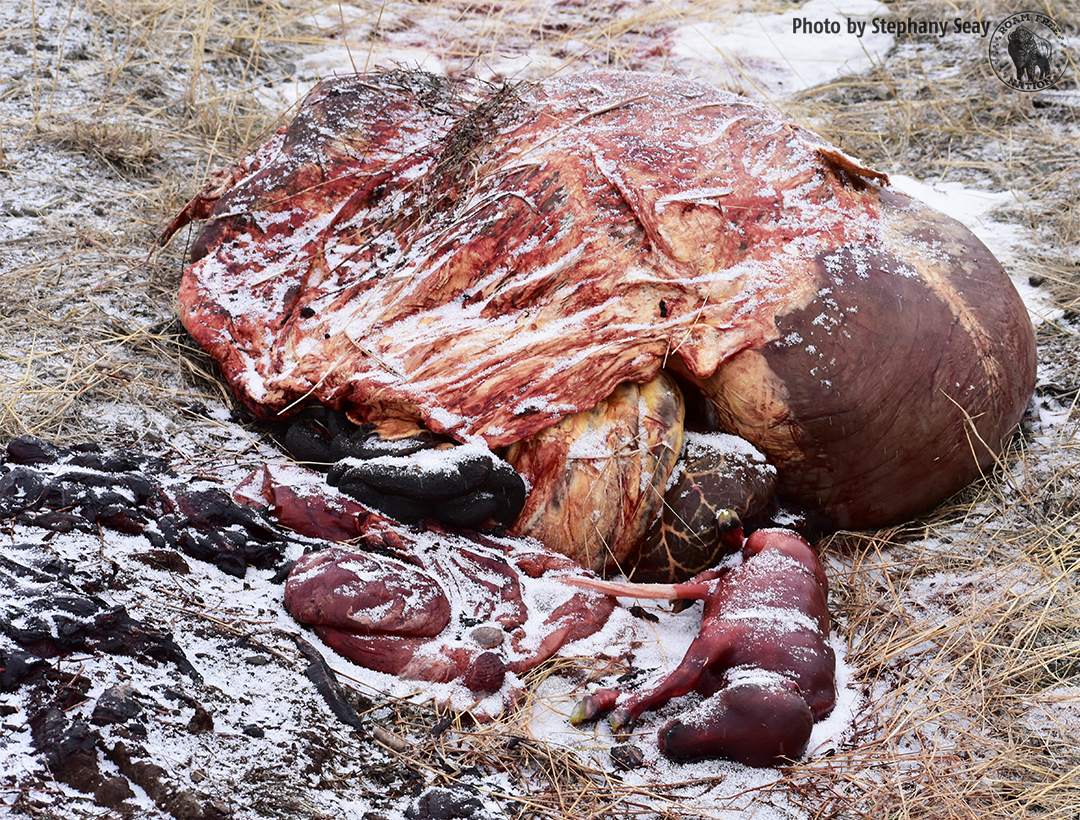
Calves like these two precious ones are being born every day, probably even at the trap or on the way to the slaughterhouse. Photo by Stephany Seay, Roam Free Nation.
Updated Numbers from Yellowstone
Yellowstone’s latest report was issued today. The numbers are astonishing! Seven hundred and sixty-eight buffalo have been shipped to slaughter! There have been ninety-seven kept in captivity for the quarantine (domestication) program. Yeah, quarantine really is such a alternative to slaughter. These humans are insane. Many of the buffalo who have been captured and sent to slaughter are pregnant females. Calves have been arriving in and around Yellowstone for a few weeks now. No doubt they are being born in the trap, too.
Fate of the Slaughtered Buffalo
We want to inform you about what is taking place with the buffalo after their bodies leave the slaughterhouse. Their meat is being sold for profit by the Confederated Salish & Kootenai tribes. The image below is of a Salish & Kootenai Facebook post describing it. Slaughtering the last wild buffalo now has a greenwash name, the Tribal Food Transfer Program, but that doesn’t change the truth – that they profit off their death.
We realize this text is small, so we attempted to link to the actual Facebook page. Turns out, I can’t share the link with you because they blocked me! But, the image does link to an article about this slaughter program. If you have any trouble with the image, you can read the article here.
It doesn’t matter who’s doing the killing, the manipulation, or the harm. In this day and age, habitat (home) is being gutted. Ecosystems and wildlife populations are crashing at an alarming rate. Scientists estimate that two hundred species go extinct every day. Harmful mismanagement is being greenwashed by state, federal, tribal governments, and big “green” groups. This human culture is blood lusting under a guise of preserving “cultural ways”. But the reality is, it does not matter who kills, harms, or domesticates sacred wildlife. It’s humans in general who are the problem and wildness, compassion, and reciprocity are the solutions. Everyone who participates in human-centric Interagency Bison (mis)Management Plan practices are betraying the last wild buffalo.
New Billboard for Wild Buffalo!
We are pleased to announce that a new billboard has gone up, with the message: Stop Slaughtering Yellowstone Buffalo. The billboard is located west of Belgrade, Montana, along Interstate 90, about two hours from Yellowstone National Park. Tourist season is starting, so it will be seen by many. Big thanks to our friends at the Alliance for the Wild Rockies and our friend Larry Laverty for making this possible!
Give Big Gallatin Valley!
For the first time, we are participating in Give Big Gallatin Valley! This is Gallatin Valley’s community’s day of giving – an opportunity to unite our community around causes in which we truly believe and help nonprofit organizations connect to the larger community. You can support our campaign by visiting our page at GiveBigGV and donating on May 1st – 2nd. We’ll remind you right before it happens!
With your amazing support we continue our fight to stop the slaughter, end these insane “hunts”, and press on for more buffalo on a larger landscape.
A baby buffalo snuggles with mom. Photo by Stephany Seay, Roam Free Nation.
Just a few days ago, the first baby buffalo of the year was spotted inside Yellowstone National Park. Despite this celebratory time of year, every single weekday, two stock trailers full of the country’s last wild buffalo have left the park’s Stephens Creek trap, headed for the slaughterhouse. The adult female buffalo who are still in the trap could give birth at any time. In addition to buffalo being sent to the slaughterhouse, the hunt-slaughter pressure continues in both basins.
Though it does seem to be tapering down a bit, the Nez Perce tribe is still “hunting” in West Yellowstone in the area of the Central herd’s calving grounds. A neighbor who witnessed some of the carnage called it a “blood bath.” We wonder how many full term baby buffalo are in their mother’s gut piles.
Two pregnant moms were killed on their calving grounds, and their dead unborn calf was all that remained. Photo by RFN supporter who wishes to remain anonymous.
Yellowstone National Park has finally started posting their Bison Operations Report on their new cumbersome website, but when we first received it, it was not up to date nor did it have very much information. These reports used to be pretty thorough, revealing how many buffalo had been captured for slaughter, for quarantine, as well as how many buffalo had been killed by state and tribal hunters, with a breakdown of how many each tribe killed. Now the report only reveals how many buffalo have been placed in quarantine (domestication) and how many have been shipped to slaughter. The current report states that:
577 have been shipped to slaughter – including 329 adult females, likely all carrying the next generation of buffalo
97 have been assigned to a life of domestication (quarantine)
1 buffalo calf was killed as a result of capture
Additionally, according to a treaty hunt support group’s website:
850 (+ /-) have been captured in Yellowstone’s Stephens Creek trap
28 have been killed by tribal hunters (as of April 3rd, more have since been killed)
2 were killed by Montana state hunters
1 was killed by a Wyoming hunter
The next Interagency Bison Management Plan will be held on May 15, in Bozeman, Montana. If you are able to make it, please attend! There is opportunity for public comment and these agencies and tribes need to hear from you! In the meantime, there are two other actions you can take:
Contact Yellowstone and tell them to stop the slaughter of pregnant moms and calves. Enough is enough!
Call Yellowstone’s Superintendent Cam Sholly at (307) 344-2002 Email: Yell_Superintendent@nps.gov Comment on their social media pages:
We do have some good news! Yellowstone Voice’s documentary, A Path Forward for the American Bison, which Roam Free Nation appears in, will be shown at the Fort Meyers Film Festival, May 14-18, in Fort Meyers, Florida. If you have not yet seen this very informative documentary, you can watch it here.
A grizzly mom and her three cubs along the Gibbon River in Yellowstone. Photo by Stephany Seay, Roam Free Nation.
Grizzly bears need our help! Montana, Idaho, and Wyoming are seeking to end federal protections for endangered grizzly bears. These states want to open up trophy hunting, which could wipe these sacred bears out. Even with Endangered Species Act protections their numbers continue to decline. Climate change is a big factor, but grizzly-human conflict also takes a heavy toll.
Montana Fish, Wildlife, & Parks is currently accepting public comments on their New Delisting Rule until May 16. Learn more and submit your comments at Save the Yellowstone Grizzly.
Thank you all for your continued support and for your love of wild buffalo and all of wild nature!
A family group of buffalo just enjoying the day. Photo by Stephany Seay, Roam Free Nation.
Jaedin and I returned to Gardiner on Saturday, March 15. We met up with friends — human and wild — inside Yellowstone National Park along Old Yellowstone Trail. One of those friends included RFN board member, Cindy Rosin, who had been in the Gardiner Basin for about two weeks. We hung out with a family group of buffalo for hours, watching them graze, play, and just be buffalo at peace.
RFN Co-founder, Jaedin Medicine Elk, sends a message to the people while sitting in front of the access road to Yellowstone’s Stephens Creek trap. Photo by Stephany Seay, Roam Free Nation.
The buffalo were just a little east of Yellowstone’s Stephens Creek buffalo trap, and barely a mile from the infamous Beattie Gulch. Yellowstone had been actively capturing and hunters were in town to make their kills. For some time it appeared that the buffalo were going to move further south, where they would be safe from trap and rifle. When most of them were just out of our sight, something must have spooked them because they came running back, heading north.
A gorgeous young female buffalo looking very pregnant as she admires her admirers. Photo by Stephany Seay, Roam Free Nation.
For hours more we monitored them, watching them inch slowly to the north. There were plenty of hunters in town and they all had their eyes on this group, too. Not too far from them was a group of four bulls. They had also been closer to Beattie Gulch than any of us cared for, and hunters were watching them as well. At some point in the day, the bulls crossed the Yellowstone River and came into a large grassy pasture where they were relatively safe. The larger family group continued to make their way north, making us all uneasy. As the sun went down a veritable blizzard rolled in making it impossible to see the buffalo at all. We had to call it a night and gather again in the morning.
In the morning, the buffalo were still south of Beattie Gulch but still dangerously close. The bulls had joined them. As they got closer to the boundary and the hunters lay in wait, we repositioned to better document the tragedy we thought was going to take place. The whole group came all the way to Reese Creek, which is the border between Yellowstone and Gallatin National Forest. Hunters were already out of their vehicles, walking up the carcass retrieval road, rifles in hand. We waited for the worst. But, wild buffalo are full of surprises. As it turned out, they just came to get a drink of water from the creek and headed south again, much to the chagrin of the hunters.
So-called hunters line up as they wait for their friends to haze buffalo towards them. Photo by Stephany Seay, Roam Free Nation.
Later that day, though, part of the family group broke away from the herd and joined the bulls who were once again heading north towards danger. We returned to our positions to bear witness to what was about to take place. Just before getting to Beattie Gulch, the smaller family group joined back up with the other herd. But, the bulls kept coming. We could also see three hunters at the boundary line, and another nineteen people — most with rifles — positioned in the middle of Beattie Gulch. The bulls couldn’t be seen from our position, but we had other people in the field who had eyes on them. At the time, they were safe. But suddenly the larger group of hunters got down on their knees. Moments later a volley of shots were fired. As we wondered what in the hell had just happened, thinking maybe they shot some elk, our other patrol showed up to say that the hunters along the boundary hazed the bulls further north and into the kill zone as soon as they stepped over Yellowstone’s boundary. Twenty-two hunters on four bulls. Sure, that sounds fair. Three of the bulls were killed then, and one managed to escape. Dark was coming and there was very little visibility. Apparently that didn’t matter to the hunters. The fourth bull was killed by them in the night. Tribal hunters can pretty much do whatever they want, no matter issues with ethics or safety. We are all pretty sure the bull came back to his fallen comrades to mourn, and the hunters took advantage and ended him, too.
Confederated Salish & Kootenai Tribes’ metal coffins on wheels leave the Gardiner Basin, headed for the slaughterhouse. Photo by Stephany Seay, Roam Free Nation.
When we got back to our room, we saw a Confederated Salish & Kootenai Tribes truck and trailer. From that, we knew that buffalo would be shipped to slaughter in the morning. Getting out there at the break of day, we had eyes on Yellowstone’s trap. Sure enough, two trucks with trailers were leaving the trap. We got into position to document. The two trucks — metal coffins on wheels for the country’s last wild buffalo — bumped down Old Yellowstone Trail escorted by law enforcement. They turned onto Highway 89 and headed for the slaughterhouse.
The family group from the day before was still pretty much in the middle between Yellowstone’s trap and Beattie Gulch. We took advantage of the respite to head up Travertine Road which is in the high hills east of the trap. We took our scopes out and noticed a couple other groups of buffalo moving into the Gardiner Basin. We set our sights on the trap and counted around 330 in the outer pens. To date, more than 400 have been captured.
Nearly 350 of the country’s last wild buffalo inside Yellowstone’s nefarious Stephens Creek trap. Video by Michelle McCarron for Roam Free Nation.
In Gardiner, wild buffalo are damned if they do and damned if they don’t. For a while they seemed to be inching their way south, away from the hunt zone. But early in the afternoon, they changed their minds. They were moving north and it did not look like they were going to stop.
The war against wild buffalo is supposedly about brucellosis, but elk carry it too and have been accused of transmitting it to cattle, yet they are free to roam. Photo by Stephany Seay, Roam Free Nation.
We got our cameras ready, had our binoculars and scopes out. As the buffalo moved into Beattie Gulch, they were still a couple hundred yards away from the kill zone. We noticed a man on foot slowly moving towards them and skirting around them. He was attempting to haze them into the kill zone. Like night shooting, hazing is also legal. Real hunting, huh? He was waving his hat around in his hand, getting closer. Part of the group got the message and bolted past him back into the Park. About twelve buffalo were still in danger. He kept trying to haze them, running them in circles. At one point one of the adult females bluff charged him. But the man was joined by two others who had rifles and they eventually succeeded to haze them into the kill zone. One shot, one buffalo down. Three more shots were fired, but the rest of the group — or so we thought — made an about face and bolted back into the Park. Both groups of the original herd took off running and didn’t stop running until they were in the vicinity of the trap.
A group of “hunters” attempt to haze wild buffalo into the kill zone – the infamous Beattie Gulch. Unfortunately, they were successful. Photo by Stephany Seay, Roam Free Nation.
We posted up across the river from the Trap and set our scopes up. These buffalo who had just been harassed and “hunted” were perilously close to the trap. We could see two men in the blue shirts of Montana Department of Livestock (DOL) walk out and open the gates to the trap. They both took out handfuls of hay, attempting to lure the buffalo into the trap. As we watched in horror, seven buffalo, in single file sampled the hay and one by one walked into the trap. Our hearts sunk. But, as we were watching, they each turned around and headed back out and kept going. One of the DOL agents came back out and shut the gate again. Disaster narrowly averted!
As we were giving thanks for this miracle, and for the fact that we saw only one buffalo get shot, we got a text from another patrol who said that, in fact, three more buffalo had been killed in that “hunt”. We couldn’t believe it. We were watching the whole time. We went back to the scene, set up our scopes and could see other groups of people scattered about. We also saw a rope tied to two trucks that went behind a hill. Sure enough, one of the trucks drove up the carcass retrieval road, while the other acted as an anchor, and a dead yearling was drug out. But, the yearling was not alone. He had a passenger. One of the hunters was actually riding him! Show some respect for your relatives, for crying out loud. We could then get a visual on two other carcasses, all yearlings. So four were taken in that “hunt”.
Right as we got home that night, two Confederated Salish & Kootenai trucks and trailers pulled in to our parking lot. Yes, more buffalo would be shipped to slaughter in the morning. We were there to say goodbye to our friends as the metal coffins drove them to their doom. Over the next two days, two more trailers full of the country’s last wild buffalo left the Gardiner Basin. With so many buffalo still in the trap, and others possibly in danger of being captured, this will be a regular occurrence until the trap is empty, while simultaneously buffalo outside the trap are consistently threatened with rifles.
What can we do about this? How do we stop it? There is really nothing we can do about the tribal hunts, other than pray very hard that the buffalo are granted Endangered Species Act protection. Under the current administration that doesn’t seem very likely. But we can continue to put pressure on Yellowstone.
Call Yellowstone’s Superintendent Cam Sholly at (307) 344-2002 Email: Yell_Superintendent@nps.gov Comment on their social media pages:
This senseless, needless, disrespectful, selfish maltreatment of the country’s last wild buffalo must end! Until it does, we will endlessly apply endless pressure and show the world was is taking place with these gentle giants. We are able to do that because of you. We thank you from the bottom of our hearts for allowing us to stand with the buffalo and tell their story, sharing their perspective.
Roam Free Nation cofounders, Stephany Seay and Jaedin Medicine Elk, made another journey to Gardiner, Montana this week. As we entered the Gardiner Basin, there were buffalo everywhere. Hundreds and hundreds of the gentle giants graced the land, spread out all over the Basin. We were, of course, anticipating the worst, especially with so many buffalo out, but to our pleasant surprise, there were hardly any hunters there and not much killing relative to how terrible this season has been. At first we started to wonder if maybe the hunters had realized that they killed way too many buffalo (one is too many from this imperiled population) and decided to hang up their rifles. We were wrong.
The second day we were there, there was a single buffalo killed at the infamous Beattie Gulch. The next day two were taken: one at the gut pile-covered Beattie Gulch, and another in Cutler Meadows, which is the buffalo’s northernmost habitat where they are “tolerated.” On our last day there, two more were killed at the Cinnabar River Access, which is between Beattie Gulch and Cutler Meadows. While it really sucks that more buffalo were killed, it was not the killing frenzy that we have so often witnessed and come to expect. One of the hunts was actually the most respectful we’ve ever seen. A group of hunters started at Cutler Meadows, where about 200 buffalo were grazing and playing.
The buffalo knew something was up, and as soon as they saw the hunters, they all fled over the hills and onto Church Universal & Triumphant (CUT) land, where no hunting is allowed. However, there was still a bachelor bull group there and we though for sure at least one of those big boys was doomed. To our surprise, the hunters got in their vehicles and headed out. We kept an eye out and followed. Unfortunately, there was a family group at Beattie Gulch, and that’s where the hunters went. But, they didn’t just start blasting away. They took their time. A very long time, in fact. This kind of patience is so rare. When one of them finally pulled the trigger, the buffalo went down with a single bullet – another thing is is also very rare. We share this not to celebrate the hunt in any way, but just to give some credit where it’s due. That kind of patience and skill is almost never seen during these “hunts.”
A Montana Department of Livestock truck and trailer cart away the wasted parts of dead buffalo from the killing fields of Beattie Gulch. Photo courtesy of Yellowstone Voices.
These hunts, as we’ve said, are really just an extension of Yellowstone’s slaughter. This year has been the worst yet, as you know if you read our report. Beattie Gulch has, as usual, seen the worst of it. It is so very bad that there are literally gut piles spread everywhere just feet from each other. Hundreds and hundreds of them. A lot of the locals complain about them, worried about waking grizzly bears, and the sad unsightliness of it all. They are a danger to any scavengers who will eat them because they are full of lead. Well, the Forest Service and the Montana Department of Livestock are doing a little “clean up” of these gut piles at Beattie Gulch. What other hunt do you know of has such horribly concentrated gut piles that humans feel the need to clean them up? That they are doing so is yet another testament to horrific nature of this unjustifiable slaughter.
During our time there, with nearly 1,000 buffalo spread out in the Gardiner Basin, the most dangerous thing was the highway. Many different groups of buffalo were east of the Yellowstone River and up along Highway 89, a dangerous stretch of road for wildlife. During the daytime buffalo are usually safe from collisions, though some residents have very little tolerance for wildlife on or near the road and make some pretty stupid moves, like not slowing down when passing a herd. There were plenty of signs up to help warn traffic, but too often those warnings are ignored. The worst time for buffalo along the highway is at night, when thy are almost impossible to see until it’s too late. Luckily, while we were there, no buffalo were hit. Some elk, however, were not so lucky. These collisions could so easily be avoided if Montana would get it together and implement safe passage infrastructure. It’s a no-brainer, especially right on the edge of Yellowstone National Park. The Gardiner Basin is one of North America’s largest wildlife migration corridors, used by buffalo, elk, mule deer, pronghorn, big horn, wolves, grizzlies, and many others.
Since the hunt started in 2005, big bull buffalo have been a major target. So much so that we began to see them less and less. In fact, in the high hills way above the Yellowstone River to the east along Jardine and Travertine Roads, which used to be teeming with buffalo, bulls all but disappeared from there. You hardly see any buffalo on those lands these days. But with the snowpack inside the Park making life so difficult for the buffalo, we were seeing tons of massive bulls on lands along the Yellowstone. We hope they play it smart and stay out of the hunt zones until things settle down by the beginning of April. All buffalo are works of magic, but it is really something to be in the presence of those really big, mature bulls. Another thing we were seeing were adult females with multiple yearlings. This means their moms were killed. Luckily buffalo do adopt, giving the babies a bit of a better chance for survival.
On a quiet late morning we decided to check out the new road that leads you into Yellowstone from the north entrance. Many of you probably recall the intense flooding that took place this summer. Inside and outside the park, roads were washed out, houses floated down the river, and lives were lost. As it was the peak of Yellowstone’s visitation season, they rapidly went to work trying to get that part of the park reopened. They did not repair the old road that took you through the canyon, along China Garden, and the Boiling River. They built a new road to the west, on an old re-grown roadbed. The road is nuts! It’s very steep and very windy and we have no doubt it will cause some trouble. It was also quite boring. No more hot soaks in the Boiling River.
All in all, our time there was mostly pleasant, spending quality hours and days with the buffalo. It is always so healing to be in their presence. As another small service to them, we are working with our allies at the Alliance for the Wild Rockies to draw more attention to the farce of the “hunt.” On Monday, a billboard reading “There is No Hunt. It’s Slaughter!” was put up in Helena, Montana. On Thursday, another billboard was put up in Billings, Montana along I-90. There will be two more going up very soon – one that hunters leaving Gardiner will most certainly see. Maybe it will give them pause to understand that they are being used as tools by Montana livestock interests to facilitate the destruction of the last wild buffalo. Our accompanying opinion editorial can be read here and our latest press release here.
Each of these numbers was a beautiful wild buffalo.
As a follow up to our report from yesterday, Yellowstone National Park submitted their current report on the wild buffalo who have been eliminated from these sacred herds, and the numbers are grim. Keep in mind, these aren’t numbers, they are wild buffalo. The Yellowstone population is being considered for Endangered Species Act protection, which makes this even more outrageous. This is what state, federal, and tribal governments are doing to the country’s National Mammal.
You can review the report for yourself, but we offer you a breakdown that may be a bit easier to comprehend.
The matriarchs are the glue that holds the herd together.
To date, and it is only early February:
Total eliminated from the last wild herds by government & tribal action: 1,024
Gardiner = 991
West Yellowstone = 33 (this does not include those killed on the highway)
Hunters have killed 527.
33 of those were taken in West Yellowstone, the rest were taken in Gardiner.
State hunters have killed 55.
Tribal hunters have killed 421.
Note of interest: the Crow Tribe is now listed as hunting under treaty right, so now there are eight tribes descending upon Yellowstone buffalo.
Another 37 buffalo are listed as “Other” casualties of the hunt – it is unclear what this means.
Yellowstone National Park has had to euthanize 13 buffalo who were shot by hunters and fled into the park terribly wounded.
On the west side, 1 injured buffalo was killed by Montana Fish, Wildlife & Parks.
Capture for Slaughter or Domestication:
Yellowstone National Park has consigned 88 wild buffalo to slaughter.
Another 14 are being held for “release or slaughter”.
Capture has resulted in the capture pen deaths of 2 buffalo.
Yellowstone National Park has consigned 55 buffalo for domestication (quarantine).
Yellowstone is holding an additional 338 for quarantine “selection”.
Note of interest: Yellowstone has stated that no buffalo have been tested for brucellosis this winter. While the testing is terribly flawed, it makes no sense how they are determining which buffalo they send to slaughter or quarantine if they are not testing them for exposure to the livestock disease.
Toll on the matriarchs:
At least 339 adult females (most of them pregnant) have already been killed or otherwise removed from the population:
130 killed in the “hunt”
72 slaughtered
137 await their fate in the quarantine selection pens
We all know how terribly important the adult females — the matriarchs — are to the health, wisdom, and longevity of the herds.
Wild buffalo are being decimated by the mismanagement of the IBMP.
Each of these numbers were once wild and free buffalo, living their lives as Nature intended. These numbers — these buffalo deaths and removals — are dangerously high for so early in the Interagency Bison Management Plan’s mismanagement season. Both capture and hunting will continue for the next two months, and hunting will continue almost year-round.
This is a travesty, and right now, we see no end in sight. Nearly 1,200 buffalo have been documented in the Gardiner Basin alone, which is a huge migration. Both members of the imperiled Central herd and the Northern herd are getting absolutely hammered right now.
PLEASE TAKE ACTION! Please contact Yellowstone Superintendent Cam Sholly and urge him to stop this senseless slaughter! He knows it’s wrong. He’s just doing the bidding of Montana’s livestock industry. Tell him to stand up for the buffalo with his actions as he has done with his words. Tell him to represent the people who he works for — which is us. Speak from your heart and hold nothing back! The fate of the 352 buffalo currently in the trap – and of any captured in the future – is in our hands.
CONTACT: Cameron (Cam) Sholly, Superintendent Yellowstone National Park P.O. Box 168 Yellowstone National Park, WY 82190-0168 Phone: (307) 344-2002 Email: Yell_Superintendent@nps.gov
And, please, pray very hard (or send your strongest positive thoughts) for the buffalo who remain…
A young buffalo awaits her fate in Yellowstone’s trap.
As we feared would happen soon, Yellowstone National Park began transferring members of the last wild buffalo herds to slaughter! Stock trailers operated by the Confederated Salish & Kootenai Tribes left Yellowstone’s Stephens Creek buffalo trap last Friday, and then again on Wednesday. The buffalo will be driven in these metal coffins over 250 miles to the Flathead Indian Reservation. There they will be taken to White’s Meats in the town of Ronan, the absolute end of the road for them. The tribe has put out a notice saying that buffalo meat will soon be available to tribal members for purchase. They are profiting off of wild buffalo slaughter. What kind of sacred relationship is that?
Just last week, Roam Free Nation counted at least 150 buffalo inside the trap. There is no question that Yellowstone will be opportunistic and capture many more than that. After being lured with hay into the outer catch pens, the Park (dis)Service moves the buffalo deeper and deeper into the trap, into pens that are much smaller and very sturdy. Family groups are separated, mothers and children torn apart. The terrified buffalo are run through an industrial strength livestock squeeze chute. Many suffer injuries in the chute — which used to be called “The Silencer” until public exposure forced the Park (dis)Service to spray paint over the gruesome name — horns get broken off when the trap operators slam a door that aims to hold a buffalo’s head still.
In here they are weighed, teeth are examined for age, and blood is drawn to test for brucellosis. These tests are absolutely inaccurate because blood tests can only determine exposure. Nine times out of ten, exposure means a buffalo has developed resistance (antibodies) to the cattle disease. The only way that actual infection can be determined is with a culture test, meaning the buffalo is already dead. More than 95% of buffalo who have been culture tested over the past couple of decades have all be found to hold resistance to brucellosis. But then it’s just too late because they are already dead.
The terror of the “Silencer” is the same, even if the name or the year changes.
With these inaccurate blood tests, those buffalo who test negative may be slated for domestication (quarantine). Those who test false-positive are slated for slaughter. It is an absolute travesty befalling our sacred buffalo, the country’s National Mammal.
Yellowstone’s Stephens Creek buffalo trap is located inside the park, barely a mile from the northern boundary, across which are the killing fields of Beattie Gulch. Just trying to survive, following their ancient migratory instincts as Mother Earth intended for them to do, buffalo are damned if they do and damned if they don’t. In the land where the snow is less deep and food more available, in one direction lies the trap, in the other the killing fields. To date, possibly 600 buffalo, certainly no less than 500, have fallen to “hunters” bullets.
National Park dis-Service – happy to be working for Montana livestock interests.
Yellowstone is acting contrary to their own science-based information. They have publicly stated that the park alone can sustain upwards of 10,000 buffalo! The population is now hovering around 5,000. They have stood up to the Montana Department of Livestock in meetings, yet they are bending over backwards to do their will. The only reason they are operating this trap and allowing wild buffalo to be mistreated and killed as livestock are, is to appease the unfounded fears of Montana’s cattle interests unfounded fears. There has never once been a single documented case of wild bison transmitting brucellosis back to the cattle they got it from. In fact, there have been over twenty cases of elk transmitting brucellosis to livestock, yet elk are free to roam. Make no mistake: this war against wild buffalo is all about the grass and who gets to eat it.
TAKE ACTION! Please contact Yellowstone Superintendent Cam Sholly and urge him to stop this senseless slaughter! He knows it’s wrong. He’s just doing the bidding of Montana’s livestock industry. Tell him to stand up for the buffalo with his actions as he has done with his words. Tell him to represent the people who he works for — which is us. Speak from your heart and hold nothing back!
CONTACT: Cameron (Cam) Sholly, Superintendent Yellowstone National Park PO Box 168 Yellowstone National Park, WY 82190-0168 Phone: (307) 344-2002 Email: Yell_Superintendent@nps.gov
Buffalo are damned if they do, damned if they don’t. The buffalo who had been staying safe the past few days on CUT land walked into Beattie Gulch this morning. Lots of hunters were there ready with their rifles. A group of young native hunters walked out towards the buffalo, and as they got closer, began to shoot. In the span of just a few minutes, four went down. An accompanying adult in the background shouted, “Get another one!” And then it was over.
As the buffalo moved south into other portions of Beattie Gulch, more shots were fired. At least two went down that we could see, but no doubt there were more. As all of this was going on, some state hunters from Minnesota headed up Beattie Gulch right along the park boundary. The one holding the tag was hoping to get a buffalo with his bow, with a rifle for back up. The buffalo made it back to the park before he was able to kill.
Wild buffalo need to be free to roam – same as any other wildlife species.
It was such a sad procession to see these buffalo leave their land. They just don’t ever get a break. Going into the park they are safe from the hunters, but threatened by Yellowstone’s trap.
Trucks piled with buffalo parts.
After we left that scene, we drove around some rental cabins where some Yakima hunters were staying, their trucks loaded with buffalo body parts. Apparently, this is heavily frowned upon by the “homeowners association” so my friend, who owns some of those cabins, wanted photos taken. Well, as we were taking pictures, one of the hunters was in the truck and stepped out. What could have been a tense situation turned into a constructive conversation. From the hunter’s perspective, though, it is all about sovereignty and exercising rights. There is no consideration for the buffalo’s perspective, which is terribly sad. It’s all so human-centric, with the buffalo being pawns in this terrible game. We got his contact information, so I will be reaching out to him to continue the conversation and share what is truly happening with the last wild buffalo, and discuss things far beyond “rights” and human interests.
For now, I am packing and about to head out for a spell. But, as we said, myself and others with Roam Free Nation will soon return. We will always represent the buffalo’s perspective. We are buffalo-centric. We are the only true voice they have!! Please support our work to defend these sacred relatives!
Even at point blank range, this shooter could not quickly end this bull’s suffering.
It seemed that this morning might start off a little quiet. There weren’t many trucks around and no buffalo were visible around Beattie Gulch. But then, shots were fired, way back in the hills of Beattie Gulch – too far to see with the naked eye, or even binoculars. I scanned the land with my spotting scope and landed on a woeful scene: three huge bull buffalo had been shot. Two were dead, one looked like he was just bedded down, but we knew he had been hit because no buffalo would stay bedded down like that while his buddies had been killed.
The one gunner who hadn’t killed “his” bull just stood there as the bull lay suffering. Over the course of twenty minutes, he fired nine more shots – walking away from time to time, reloading his rifle, taking his time as the bull suffered. Eventually, the hunter just walked away and joined his party while the bull was left there to bleed to death. If you choose, you can watch a web cam video of this, courtesy of Yellowstone Voices. While the video description says the bull was shot seven times, we know from our observation it was at least ten.
After that heartbreaking scene, I ventured out on a recon to check on the buffalo who had come through Beattie Gulch last evening, miraculously unscathed. They were all safe on private land, yet their number had grown by about 150! Close to 300 buffalo were moving freely near Devil’s Slide. Still shocked that none of them were shot when they moved through the hunt zone the day before, I later came to learn that there are agreements to “use discretion” when trucks are on the Forest Service access road – or “buffalo retrieval road” – as to whether to shoot or not. Maybe that’s why the buffalo were free to move through Beattie Gulch, or maybe the hunters had had their fill for the day. Hunters have definitely had their fill generally speaking; over 400 buffalo have so far been killed in the Gardiner Basin.
Yellowstone’s Stephens Creek buffalo trap is full of buffalo destined for slaughter or domestication (quarantine).
From there, I headed to the McConnell river access road to get a good look at Yellowstone’s Stephens Creek buffalo trap. The Park has been luring buffalo into the trap with hay over the past few weeks. Their destination is slaughter or domestication (quarantine). To view the trap, I had to use the spotting scope, because Yellowstone does not want the public to see what is going on there. They enforce a closure around the trap that is seven miles long. You have to find “perches” elsewhere in the Basin to get any kind of view.
I was able to count 145-150 buffalo inside the outer catch pen, which is the first part of the trap. The other pens deeper into the trap were empty, so they have not yet started the nightmarish “working” of the buffalo, where they tear families apart, run them through a terrifying squeeze chute, and separate them by age and sex until they are loaded onto stock trailers headed for slaughter at White’s Meats in Ronan, Montana; or they are put into the quarantine facility where they will lose their freedom and home forever. Yellowstone also has a quarantine facility at Stephens Creek and the holding pens have been significantly expanded, but thankfully, those pens are empty now.
The killing fields of Beattie Gulch covered in buffalo gut piles.
This afternoon, I took advantage of the opportunity that no hunting was taking place, and hiked up into Beattie Gulch. I wanted to take a look at and document all the gut piles. I knew it would be bad, but it was even worse than I thought. There are gut piles everywhere, pieces of hide, wasted meat, and so sadly, in so many of the gut piles were baby buffalo who will never be given the chance to roam free.
One of many unborn calves in that field that will never live to roam.
They say if you want to keep a population down, or reduce it, to kill the females. Well, that is exactly what these hunters are doing. So many adult females are killed during the hunt, and most of them are pregnant. The adult females are the matriarchs, the keepers of the wisdom, the teachers, the ones who know and show the youth where and when to migrate, where the best grass is, where the safest watering holes are. They are the ones who give knowledge to the younger buffalo, who will then teach their children. With the loss of every adult female is not only the loss of a calf, but the loss of migratory memory and ancestral wisdom.
This is no hunt, it is a slaughter.
Not an hour after leaving Beattie Gulch, I checked on the buffalo who were still safe on CUT land and then ventured into the Park to check on others. As I was crossing the boundary to the south, buffalo were starting to cross the boundary to the north, heading straight for the killing fields of Beattie Gulch. I turned around and got my camera and scope set up, and as I did, no less than 200 buffalo began streaming across the park boundary heading straight for Beattie Gulch. In a normal, healthy world, witnessing that beautiful motion of the flow of buffalo moving across the landscape is a thing of celebration, beauty, and joy. And it still is, but knowing what their fate will be brings a heavy bittersweet taste to the event.
The buffalo just kept coming and coming out of the park, such a sight to behold. And the hunters were waiting for them. They held back until the buffalo moved just inside the hunt zone, and opened fire. At least 20 shots were fired, but it had started snowing so much that it was difficult to see how many actually went down. The vast majority of the buffalo, as they usually do, made an about-face and fled back to the park. This is exactly why buffalo restoration will never happen so long as this kind of “hunt” takes place.
Tomorrow, regretfully, I have to leave for a little while. But I, along with others from Roam Free Nation, will soon return. We need to be here to represent the buffalo’s perspective, to tell the truth about what is really taking place here. We urge you to lend your support to enable us to be a formidable and constant presence in the field. Please consider making a donation in support of our work. And if you can’t make a donation, you can still help wild buffalo by taking action on their behalf. Thank you so much for caring so deeply about these last wild herds!
Arising at 6:30 this morning, it is still velvety dark. I get ready for patrol, ready to be out there at first light when the “hunters” will be there. As I prepare, trucks already begin to arrive at the Beattie Gulch trail head. Seven hunt rigs soon make a bee-line to the north. Last evening a group of about 175 buffalo were north of Beattie Gulch on Church Universal & Triumphant (CUT) land, where they are safe. Being migratory, we knew they wouldn’t stay there long. I gather my things, warm up the car and head out. Sure enough, there are now no less than now fifteen hunt rigs lined up along the north boundary of Beattie Gulch. In the night, the buffalo had moved south into the hunt zone – better known as the killing fields of Beattie Gulch.
Hunt rigs line the boundary of Beattie Gulch in the pre-dawn light.
The beautiful woollies were all bedded down, peacefully awaiting the morning sun. The gunners didn’t care. They poured out of their warm trucks, rifles in hand, and headed towards the buffalo. Shots began to fire off, over and over and over. More than forty shots were fired. Buffalo who had not been hit – or at least not fatally hit – were running back towards the relative safety of the Park. But many fell. Down, down, down they went. Not all were killed. Many were left shot and suffering as the gunners pursued other buffalo, the wounded left wriggling and writhing on the cold ground. One last near-yearling was left, wondering where mom went, unsure of what to do. A rifle made the decision for her. From our vantage point, we counted thirteen bodies, but we know there are more.
Soon after the killing was over, most of the trucks went up a Forest Service access road, known as “the recovery road” where they are allowed to drive in to make it easy for them to retrieve their buffalo.
This is not a hunt. It is a slaughter.
Leaving them to their field dressing, I ventured into the park to get counts on buffalo in danger of being captured for slaughter or domestication (quarantine), or those who may head north back towards the killing fields. The lands around Yellowstone’s Stephens Creek buffalo trap are teeming with buffalo. There are no less than 600 of the gentle giants gracing the landscape. It is a wonderful, beautiful sight until you remember what fates may await them.
As I write this, a small group of thirteen bulls and one female (an odd dynamic) are getting dangerously close to Beattie Gulch. We are watching closely.
Later in the afternoon, that group of fourteen suddenly turned into a group of about 120. They were headed right down Old Yellowstone Trail, almost across the Park boundary into Beattie Gulch, when they just stopped. They were sniffing around, and some of the bigger bulls started bellowing, like they do when in mourning. Their tails were up, and a sense of unease could be felt among the herd. They could probably smell all the death at Beattie Gulch. It seemed that one big bull in particular wanted to turn the group around, but they continued to stand there.
A few adult females were restless and wanted to go where they could find food, danger be damned. So, a matriarch lead her small family group right into Beattie Gulch, where hunters were still busy field dressing their kills from this morning. The rest of the group remained standing at the Park boundary, but eventually, the dam broke, and they all came into Beattie Gulch, walking right into the hunt zone. We were certain there was going to be another massacre and so we stood watch, ready.
At one point, the first small family group walked right up to where the hunters were field dressing a female – probably a friend of theirs. They walked right up to the hunters’ kill site to pay respects to their relative. Fortunately, the hunters let them have their time and backed off. So often when buffalo come to mourn, hunters will throw stones or sticks or snowballs at them to chase them off. Giving credit where it’s due, these folks allowed the buffalo their time. Then another group approached, and the same was granted. Eventually, all of the buffalo were in the heart of the hunt zone and we waited for shots to be fired, but, none ever came. I guess the hunters had their fill.
A small portion of that large group bolted back into Yellowstone, reasons unknown. The rest are currently safe on private property. But who knows where they will be in the morning, and, as they say, tomorrow is another day.
There is no way that natural wild buffalo restoration is going to happen with what is taking place on the edge of Yellowstone National Park. Barring Endangered Species Act listing, the buffalo really don’t stand a chance. Please be a voice that gives them that chance and take action now.
WILD IS THE WAY! ROAM FREE!
P.S. Web cam footage from Yellowstone Voices will soon be available, and when it is we will share it with you.
As of January 22nd, 2023, Roam Free Nation has returned to Gardiner, Montana on the north side of Yellowstone to monitor, document, and give a voice to wild buffalo. Watch this space for regular reports!
RFN Report from Gardiner – 1/22/23
Roam Free Nation is present in the Gardiner Basin, along the northern boundary of Yellowstone National Park. There are hundreds of buffalo in the Basin, many of them in safe zones closed to hunters, but many others around Yellowstone’s Stephens Creek buffalo trap, and still others inside the trap slated for slaughter or domestication (quarantine). Two bulls who were at Beattie Gulch early this evening fell to the bullets of ‘hunters’. They are visible outside my window, truck lights blaring in the dark as they carve away on the remains of two of the country’s last wild buffalo. And those in the safe zones will not remain there, as buffalo are a migratory species. So, the hunters will watch and wait and kill as many as they can when the opportunity strikes.
Seen on the road near Missoula, a truck returns from the killing fields with a pile of dead buffalo.
In Gardiner, more than 120 buffalo have been shot and killed in this slaughter being disguised as a hunt. Far more than that when you count all the near-term calves left in their mother’s gut piles, and those who were wounded and fled back into the Park, later to be shot by park rangers. Countless calves have been orphaned as well, but thankfully, buffalo will adopt. But still, to see these calves mourning and searching for their lost mothers is heartbreaking. Gut piles are all over the place, a dangerous feast for many scavengers who will be poisoned by the lead in the hunters’ bullets.
Ironically, many of the people doing this killing say that they want more buffalo on a larger landscape, but by their very actions, they are preventing wild buffalo from accessing available habitat and having a chance to restore themselves. They are also causing the loss of migratory memory and changing the dynamics of herd behavior. They claim they are “forced” to come kill in this manner, but it is their choice to participate in this extension of government slaughter.
We are staying with friends from Yellowstone Voices, who have a web cam set up to gather footage of the killing fields of Beattie Gulch. If you go to yellowstonevoices.org and scroll down to the second video, you can see for yourself the horrible things that happen daily at Beattie Gulch. This video was taken only yesterday.
We will bring you more news and images and the truth about what is happening to the last wild buffalo as tomorrow morning comes.